About March for Babies

About Masthead

March for Babies

March for Babies brings people together through events across the country and online while raising critical funds to tackle America's maternal and infant health crisis—one person, one community, and one step at a time.

The US is among the most dangerous developed nations for childbirth. When you participate, you're helping March of Dimes:

  • Provide programs like NICU Family Support® for families with a baby in the NICU, and promoting healthy pregnancies with Supportive Pregnancy Care®.
  • Deliver prenatal care where it's needed most with March of Dimes Mom & Baby Mobile Health Centers®.
  • Fund research and innovation to address the most pressing maternal and infant health challenges.
  • Educate healthcare professionals and families with information such as our Low Dose, Big Benefits™ campaign to inform about how low dose aspirin can support cardiovascular health.
  • Advocate for legislation that protects all moms, babies, and families.

At events both in-person and virtual, participants rally to improve health outcomes for every mom and baby. Find an event near you or participate virtually at marchofdimes.org.

Start fundraising

When it comes to giving families the best possible start, we all have the power to help. Here's what you can do:

Sign up Icon

Step 1: Sign up

Sign up or log in if you’re a returning walker at marchforbabies.org. Customize your profile, find fundraising tools, send communications to friends, family, and coworkers.

Set your goal Icon

Step 2: Set your goal

Set your goal based on a meaningful number, such as a birthday, in memory of someone, or a milestone.

Recruit others Icon

Step 3: Recruit others to join your team

Much more than a walk, March for Babies is a community. Recruit 10 people that will join your team to raise funds to protect the health of families.

Have fun Icon

Step 4: Have fun!

Join us to improve the health of all moms and babies. Because together, each step forward leads to a healthy future for us all. March for Babies. Every step counts.

Register now

March for Babies calls on people across the country to come together and fundraise to make a huge difference for the health of all families.

Join us to:

bullhorn icon

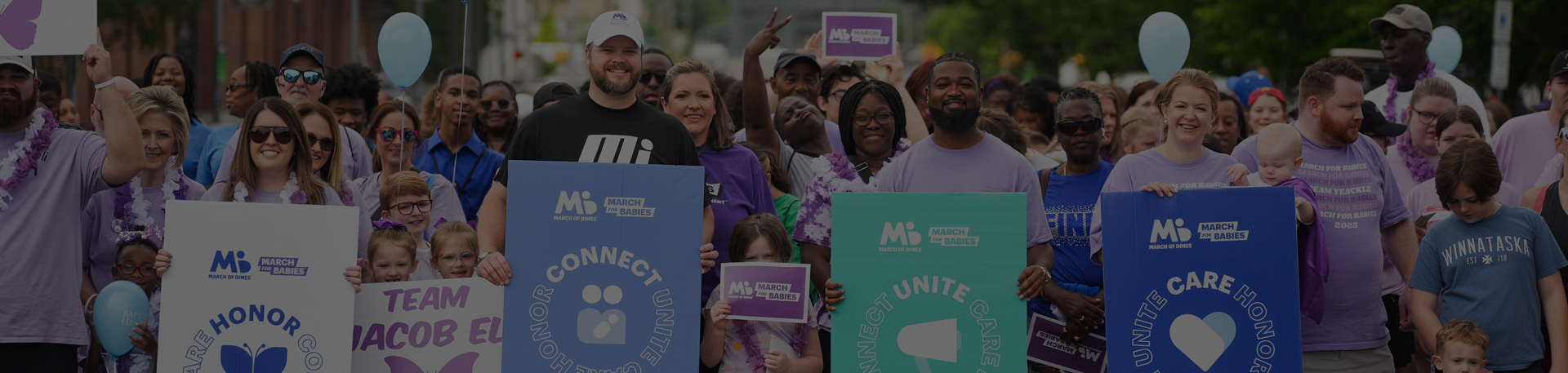
Unite

For health equity, opening the door for all moms to have access to care and protecting the health of families by advocating for their rights.

parents newborn icon

Connect

Year-round through customized challenges and team building activities that engage employees, families, and friends who want moms and babies to be healthy and strong.

butterfly icon

Honor

Motherhood, babies, and those who've experienced loss by staying active and creating change.

heart icon

Care

For all families throughout their pregnancy—whether it goes as planned or has unexpected challenges—by raising critical funds, so moms and babies get the best possible start.

Meet our families

  • Cynthia Weiss

    She spent a month watching her preterm daughter fight to survive. Now she fights for other families.

    Cynthia Weiss turned her daughter's preterm birth—and her husband's death—into a mission to help all moms and babies get the care they need.

    Philadelphia, PA—Cynthia Weiss wasn't ready when her daughter Lucy arrived six and a half weeks early in 2006. She spent 29 days in the neonatal intensive care unit (NICU) watching her newborn fight to survive.

    "As a first-time mom, I felt unprepared, nervous, and helpless as Lucy lay in the incubator with tubes in her nose, wires attached to her fragile body, and the endless beeps of machines," Cindy recalls.

    The challenges didn't end when Lucy came home. For three months, their daughter remained connected to a heart monitor. She caught up in weight, feeding, and developmental milestones. Through it all, Cindy's husband was her steadfast support.

    Lucy thrived and is now 18 years old, but Cynthia knows not all babies are as fortunate. That's why she's dedicated herself as a volunteer leader with the Greater Philadelphia/South Jersey March of Dimes, advocating for the health of all moms and babies.

    Six years ago, Cynthia's commitment deepened when her husband died suddenly. Now the annual March for Babies walk honors his memory, too. Today, she walks each year with Lucy and her younger daughter, Maddy—not only to celebrate Lucy, but to honor their dad.

    "I will never forget how he was my rock and support during those harrowing NICU days, the ultimate #girldad in caring and loving his girls," Cynthia shares. "Despite our loss, I’m grateful for the life we shared and for that support during my pregnancy. It's also a daily reminder of the work we need to do to ensure all moms and babies can experience positive outcomes."

    The funds Cynthia raises directly enable March of Dimes to support research, lead programs, and provide education, and advocacy. She invites anyone who believes that every baby deserves the best possible start and every mom deserves access to healthcare and resources to join her family at March for Babies, or support the effort through a donation.

  • Whilding Family

    A father gives back to the NICU that saved his daughter

    After his daughter's birth complications, Kasey Whilding joined March for Babies to connect with other families and support them through similar challenges.

    Birmingham, AL—When Alex and Kasey Whilding's daughter Olivia was born in 2019, medical staff quickly identified a problem. She had asymmetric crying facies, a congenital anomaly that signals an elevated risk for major heart defects.

    Then came jaundice and retracted breathing. Instead of going home, Olivia spent five days in the neonatal intensive care unit (NICU) at St. Vincent's Hospital in Birmingham, Alabama.

    "We of course were terrified, as any parents would be," Kasey recalls, "but the care and compassion she received by the nurses and staff in the NICU was incredible. We recognized it then, and it has left its mark with us ever since."

    Today, Olivia is a healthy, lively 5-year-old with no known heart defects.

    The family has sought every opportunity to show gratitude to the NICU team that cared for their daughter during those critical first days. When Kasey was invited to serve on the March for Babies Executive Leadership Team, he jumped at the opportunity.

    "This is my small way of trying to give back and say thank you to the people and organization that ensured my daughter would come home to us healthy and happy," he says. "March of Dimes does so much for babies, mothers, and families, and has certainly touched our lives in more ways than one."

  • Tiffany Vassell

    Health equity: More than just a buzz word

    Tiffany Vassell, a maternal health advocate and mom, unites sorority service and public health leadership to advance equity in maternal health.

    Boston, MA—Every spring, as Boston’s March for Babies approaches, Tiffany Vassell prepares not for one team, but for two: her Zeta Phi Beta sorority sisters and the Boston Public Health Commission’s team. For Tiffany, the walk is more than a morning through city streets; it’s a public expression of work she lives every day.

    "Zeta Phi Beta has been a long-time partner of March of Dimes," Tiffany reflects. "As long as I've been a member, we've been doing this walk and it's always an honor to raise funds and to get people to donate and to really know about this cause and how important it is."

    Tiffany’s connection to maternal health runs deep. A former labor and delivery nurse, current program director of Healthy Baby Healthy Child at the Boston Public Health Commission, and mother, she has seen the joys and challenges of childbirth firsthand. She understands how factors like neighborhood and skin color can shape outcomes, often regardless of medical need.

    "As a nurse, I've seen how systemic inequities affect families," Tiffany says. "Everyone should have access to great care. Families should be supported, respected, and able to thrive."

    These principles guide her work at the Boston Public Health Commission, an agency whose mission is to protect, preserve, and promote the health and well being of all Boston residents. She recently stepped into a leadership role in the Commission’s legacy maternal child health program, bringing fresh energy to this year’s March for Babies and marking her first time tabling at the event in her new position.

    Through her partnership with March of Dimes Boston, Tiffany advocates for expanded care options that respect families’ choices, including midwifery care and birth centers. Her work underscores a core belief: quality healthcare isn’t one-size-fits-all, and families deserve both options and dignity.

    "It's always an honor to partner with March of Dimes, whether professionally or within the community," Tiffany says.

    When asked to define health equity, Tiffany’s answer is both simple and profound. "Health equity is more than just a buzz word. It means that families—regardless of race, ZIP code, or immigration status—have access to respectful, supportive care that helps them not only survive but thrive."

  • Powers Family

    ‘Even though Luke's life was far too short, he matters’

    Each year, the Powers walk in March for Babies to honor their son—and to support to the research that helped save their three preterm babies.

    Boston, MA—For the past five years, Kellie and Jeff Powers have laced up their sneakers for Boston’s annual March for Babies walk. It's a way to honor their son Luke, who lived for just one day, and to support the research and care that helped their three preterm babies survive and thrive.

    "There isn't a lot you can do as a bereaved parent for your child after they pass away," Kellie says. "Being able to remember Luke today and honor him at this walk is really important to our family."

    The path that first led Kellie and Jeff to the neonatal intensive care unit (NICU) began on an ordinary morning. On March 8, 2018, Kellie arrived at South Shore Hospital in Weymouth, Massachusetts, for what she expected to be a routine ultrasound. Instead, she learned she was 7 centimeters dilated and in active labor with her twin daughters. She was only 31 weeks pregnant.

    The week before, she’d had a low-grade fever and chills, symptoms her doctor believed were viral. That morning, severe cramping made her fear something was wrong. After her ultrasound, a non-stress test confirmed her worst suspicion: she was contracting.

    Despite magnesium and steroid treatments to slow labor, her body wouldn’t stop. Shortly after midnight, the medical team prepared for delivery.

    At 3:54 a.m., Peyton was born weighing 3 pounds, 9 ounces. Seven minutes later, her sister Paige arrived at 2 pounds, 11 ounces. Both babies were immediately admitted to the NICU at Brigham and Women's Hospital.

    Soon after giving birth, Kellie experienced a postpartum hemorrhage. Doctors later discovered she had developed chorioamnionitis—an infection of the amniotic fluid—that had affected Peyton’s placenta. The infection progressed to endometritis, requiring a dilation and curettage (D&C) procedure to remove tissue from her uterus. Kellie spent two weeks recovering while her daughters began their own fight for survival.

    Over 39 and 42 days in the NICU, Peyton and Paige made slow, steady progress: moving to open-air cribs, gaining weight, learning to bottle-feed, and eventually passing their car seat tests. Those “small victories,” Kellie says, built toward the day both girls finally came home.

    Life slowly settled into a new normal as the twins grew. But the NICU—a place they were grateful for, but never expected to return to—would again become part of their story.

    Years later, Kellie became pregnant with their son, Luke. At 23 weeks and 6 days, complications led to an emergency Cesarean section. The Powers had just one day with him. Luke passed away in their arms that evening after developing a severe brain bleed.

    “We had one entirely too short day with him,” Kellie shares.

    Searching for answers, the family met with the maternal-fetal medicine team at Brigham. Doctors discovered Kellie had cervical insufficiency—when the cervix opens or shortens too early in pregnancy—and recommended a transabdominal cerclage (TAC) to reinforce the cervix. She underwent the surgery in February 2023.

    By the end of that year, Kellie was pregnant again. At 24 weeks, her water broke, and she was hospitalized for the remainder of her pregnancy. Thanks to the TAC and careful medical management, she remained pregnant for eight more weeks—an extraordinary achievement given her history.

    On July 15, 2024, Jack was born. He spent 25 days in the NICU, quickly coming off CPAP and focusing on feeding and growing. Kellie again faced postpartum infection and needed readmission, but Jack continued to thrive.

    During this time, genetic testing finally revealed the root cause behind Kellie’s history of preterm labor. She carries an extremely rare mutation on the GATA3 gene, causing HDR syndrome and affecting magnesium regulation. Low magnesium levels can trigger preterm labor.

    The discovery brought both clarity and heartbreak. Earlier detection might have prevented previous preterm births and possibly Luke’s death.

    The Powers family knows that this kind of research, which led to the discovery of Kellie’s genetic mutation, is the kind of work March of Dimes helps fund.

    Now, Kellie and Jeff walk each year at March for Babies for all of their children: their three preterm babies who survived because of advanced NICU care, and Luke, whose life was far too short. Every step honors Peyton, Paige, Jack, and Luke, and helps fund research that can end preventable preterm birth and give more families the chance to bring their babies home.

    “I enjoy being here,” Jeff says. “We get to celebrate how far we’ve come, but it also reminds us of what we’ve lost. Still, we’re very grateful for what we have.”

    “I would give anything for Luke to be here with us. But even though his life was far too short, he matters,” Kellie adds. “By raising funds for March of Dimes, I’m able to honor Luke and support babies like him and families like ours.”

Why we fight for our families

Baby

Each year, 1 in 10 babies is born preterm.

Building

More than 5.5 million women have limited or no access to maternity care services.

Heart

The preterm birth rate for babies born to Black moms is 1.5x higher than for all other babies.

Your support makes an impact

Moms and babies nationwide face an urgent health crisis. Every dollar you give ensures that families everywhere have healthy pregnancies and strong babies. Your support lets us continue funding research, education, advocacy, and programs and services to improve maternal and infant health.

National partners

Publix Logo HCA Healthcare Logo
Become a partner